
Tall Tales
Saturday, March 8, First Parish, Wayland and livestreamed
Sunday, March 9, Old South Church, Boston
Suzanne Stumpf and Vincent Canciello, traversi
Sarah Darling and Jesse Irons, violins
Marcia Cassidy, viola; Daniel Ryan, cello
Kelly Savage, harpsichord
The Wayland performance is co-presented by the Wayland Museum & Historical Society.
These concerts are supported, in part, by the Wayland Cultural Council
and the Massachusetts Cultural Council, a state agency.
This program features Baroque works with programmatic elements that either explicitly tell a story or
use musical techniques to create vivid narrative imagery. Such musical storytelling was unusual during
this period, but those who composed such pieces imbued them with great imagination.
La Notte (Night)
Antonio Vivaldi made use of narrative concepts perhaps more than any other composer in his day, with
his Four Seasons concertos being the most well-known example. Of his hundreds of surviving concertos,
more than a dozen have descriptive titles. Vivaldi composed three distinct versions of the concerto
called La Notte: one for flute and strings, one for bassoon and strings, and a chamber version for flute,
two violins, bassoon, and continuo. We perform the third version on these concerts, with cello playing
the bassoon part.
In this work, Vivaldi abandons his usual three-movement form to create a dramatic structure comprising
six tempo sections that flow together. That the first Presto is titled “Apparitions” and the final
largo “Sleep” encourages one to reach for a programmatic interpretation. The sections oscillate from
feelings of ominous suspense to impetuous scampering to eerie stillness, giving the impression that
whoever is experiencing this Night is not having a particularly restful one!
Concerto in G Minor, RV 104 La Notte (Night) Antonio Vivaldi (1678-1741)
Largo
Fantasmi (Presto) — Largo — Andante
Presto
Il Sonno (Largo)
Allegro
L’Apothéose de Corelli
François Couperin was the most successful of a long family line of musicians. He is mostly known
today for his solo harpsichord works, but he also had a strong interest in writing music for chamber
ensemble. During his time, the styles of French and Italian Baroque music had evolved in very different
directions. Couperin was among the first French composers to emulate the Italian style by writing
sonatas, a form that had been unknown in France. He held the music of Arcangelo Corelli as a model,
stating that his “works I shall love as long as I live.”
Couperin’s L’Apothéose de Corelli, composed in 1724, is a self-invented mythological tale of the
ascension of his musical idol Corelli to the top of Mount Parnassus, the home of the muses of poetry,
music, and learning. The work includes narration to be read prior to each movement. It is a playful,
whimsical piece, full of contrasts between delicacy and grandeur, concluding with a sense of glorification,
as though Corelli has achieved deification in the musical heavens.
Le Parnasse, ou L’Apothéose de Corelli, grande sonade en trio François Couperin (1668-1733)
Corelli au pied du Parnasse prie les Muses de le recevoir parmi elles. (gravement)
Corelli charmé de la bonne réception qu’on lui fait au Parnasse, en marque sa joye.
Il continue avec ceux qui l’accompagnent. (gaÿment)
Corelli buvant à la Source d’Hypocréne; sa troupe continue. (moderément)
Entouziasme de Corelli causé par les eaux d’Hypocréne. (vivement)
Corelli après son entouziasme s’endort; et sa troupe joue le Sommeil suivant. (très doux)
Les Muses réveillent Corelli, et le placent auprès d’Apollon. (vivement)
Remerciment de Corelli. (gaÿment)
Capriccio on the Departure of a Beloved Brother
Johann Sebastian Bach’s Capriccio on the Departure of a Beloved Brother is an early work of the master, composed around 1704. It is Bach’s only overtly programmatic work and is possibly modeled on the Biblical Sonatas of Johann Kuhnau. It was previously thought that he composed it when his brother Johann Jacob left to become an oboist for the Swedish army, but is now thought to be written for his friend Georg Erdmann on his departure to Lüneburg. Of particular interest is Bach’s charming incorporation of the post horn’s distinctive two-note call in both the aria and fugue movements to evoke the imagery of the postal carriage taking the beloved one away on his journey.
Capriccio sopra la lontananza del suo fratello dilettissimo, BWV 992 Johann Sebastian Bach (1685-1750)
Arioso (Adagio) – Friends gather and try to dissuade him from leaving
Andante – They describe the dangers which may befall him
Adagissimo – The friends’ lament
Andante con moto – Since he cannot be dissuaded, they say farewell
Allegro poco – Aria of the postilion
Fugue in imitation of the post horn
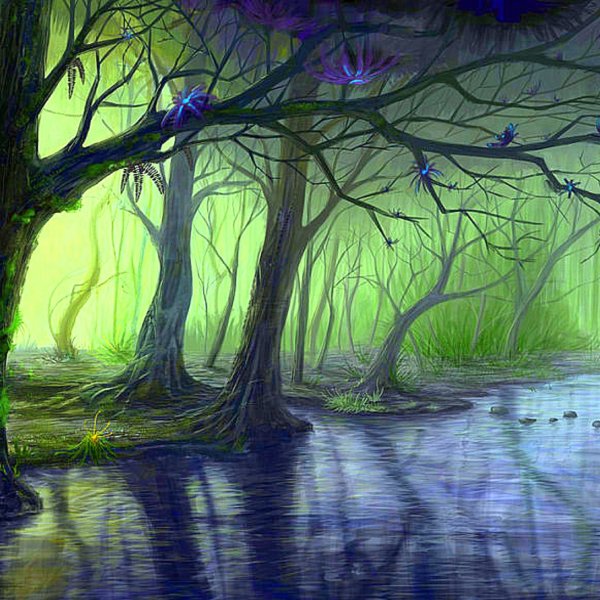
The Enchanted Forest
The Italian violinist Francesco Geminiani spent much of his career in England where he became quite popular and influential in English musical life. Born in Lucca to a musical family, Geminiani studied with Corelli, and upon arriving in England in 1714, quickly established his reputation as a teacher and violin virtuoso.
His Enchanted Forest is an orchestral work in the form of a multi-movement concerto grosso that is inspired by verses from Torquato Tasso’s epic poem Gerusalemme liberata—or Jerusalem deliver’d, as it was known in England. Geminiani composed three versions of this work. The first premiered in 1754 as the music for a staged pantomime spectacle in Paris. It is unfortunate that this version does not survive, because it is the only version that would have provided specific directions as to which parts of Tasso’s
poem went with the musical content. The later versions were intended for concert rather than staged performance, hence no indication is included about the correspondence between verses of Tasso’s poem and individual movements of the piece. We have surmised the dramatic arc of the work using clues in the musical content.
Synopsis:
This tale, set during the Crusades of the Middle Ages, opens with a scene of the destroyed siege engines used by the Franks in battle. The sorcerer, Ismen, foresees that the Franks will seek to reconstruct the engines by taking wood from a neighboring ancient forest, a place where witches gather to celebrate their mysteries with the demons. At night, Ismen goes into the forest to cast spells
summoning spirits to chase away the intruders who would harvest wood. He orders the spirits to strike them with the fear of death and cause them to flee in terror. The act ends with a gathering of the witches to celebrate Ismen’s success and accompany him on his return to Jerusalem.
The Enchanted Forest (Part I) Francesco Geminiani (1687-1762)
Andante [Scene of the destroyed siege-engines]
Allegro moderato [Scene of the tall forest, thick with ancient trees]
Andante [Darkness of night descends upon the forest casting a mournful shadow]
Allegro moderato [Gathering and dance of the witches]
Andante - Adagio [The sorcerer enters the forest and begins his work]
Allegro moderato [The sorcerer rotates in circles to prepare for casting spells]
Andante spirituoso [The spell: the sorcerer invokes the forest spirits to save the forest]
Adagio [Sorcerer awaits the spirits’ appearance]
Allegro [The spirits arrive, some from the air, some from the depths of the earth]
Grave [A panoply of sounds of the forest spirits strikes fear in the intruders]
Allegro moderato [The intruders flee and the witches celebrate]
—PROGRAM NOTES BY SUZANNE STUMPF AND DANIEL RYAN