
Ben Franklin’s Musical Curiosity
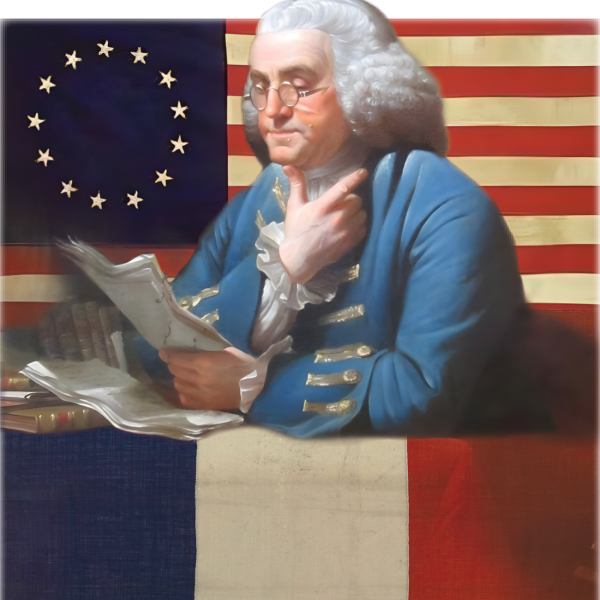
Saturday, May 2, Museum of Worcester and livestreamed
Sunday, May 3, Shirley-Eustis House, Roxbury
Joky blythe and gay Scottish song arr. by James Oswald (1710–1769)
O’er the Hills far away Francis Hopkinson (1737–1791)
My gen’rous heart disdains
Trio in D Minor for two violins and cello John Antes (1740–1811)
Allegro • Andante un poco Adagio • Presto
Quartet in F Major for three violins and cello attrib. to Benjamin Franklin
[Intrada] • Menuetto • Capricio • Menuetto (1706–1790)
The Stol’n Kiss William Hayes (1708–1777)
Trio in D Major for piano, flute, and cello Johann Christian Bach
Allegro con brio • Menuetto (1735–1782)
Sonata in G Major for violin and continuo Jean-Pierre Pagin
Cantabile • Allegro • Allegro (1723–1799)
L’amour charmait ma vie Anne-Louise Brillon de Jouy (1744–1824)
Marche des Insurgents Brillon de Jouy
Hymne à l’amitié (excerpt) Louis-Charles Demignaux (1731–1809)
Emily Siar, soprano
Suzanne Stumpf, Classical flute
Sarah Darling and Jesse Irons, violins
Marcia Cassidy, violin and viola
Daniel Ryan, cello
April Sun, fortepiano
The Worcester concert is offered in honor of William Wallace in celebration of his retirement as Executive Director of the Museum of Worcester after nearly 50 years of service. It is supported by the Fletcher Foundation and co-presented by the Museum of Worcester.
This program is funded, in part, by Massachusetts 250 and the Massachusetts Office of Travel and Tourism.
Program Notes
Benjamin Franklin garnered great renown as a consummate statesman, but his tremendous curiosity and dilligent investigation led to expertise across a wide variety of subjects including printing, agriculture, mathematics, electricity, mechanics, physics, and music, among many other areas. He contributed to the field of music as an amateur performer, music critic, and the inventor of the glass armonica.
Franklin’s own writings, as well as those of his friends and colleagues, reveal the importance of music and musical associations in his life. He and Thomas Jefferson enjoyed making music together—Jefferson on the violin, while Franklin played guitar. He knew and corresponded with America’s first native-born Classical composer, John Antes, and he became a strong advocate for compositions by Francis Hopkinson.
Period documentation reveals Franklin’s strong musical preferences. He was not a fan of French and Italian opera and greatly preferred the straight- forwardness and simplicity of Scottish songs, citing the Scotch tune performances of composer James Oswald as a model. This aesthetic inclination is also in keeping with Franklin’s advocacy for the common man. After Francis Hopkinson’s father passed away when Francis was only 14, Franklin took him under his wing, sponsoring his education at the College of Philadelphia. The two shared inquisitiveness in scientific topics as well as a passion for music. Franklin was optimistic about the development of arts in America but also keenly aware of how far the young republic lagged behind England and other European countries. It was with great enthusiasm that he shared Francis’s songs with both English and French associates, inviting them to “enjoy the American Muse.”
John Antes grew up in the Moravian community in Bethlehem, Penn., and likely first crossed paths with Franklin when the statesman visited Bethlehem in 1756. Antes was just 16 at the time. Franklin wrote to his wife about being impressed with “the very fine music” he heard in the church there. Antes later paid a surprise visit to Franklin in Philadelphia, and they eventually began corresponding with each other through the years. A set of quartets he mailed to Franklin appears to have been lost, but Antes’s surviving set of string trios, op. 3, displays his lively imagination and fine craftsmanship.
The Bibliotheque Nationale in Paris preserves a manuscript copy of a quartet for three violins and cello, attributed to “Benjamin Francklin”. This c. 1778 source is one of a few of this work, but the only one that attributes it to Franklin. The quartet is unusual in that it utilizes unconventional tunings for the instruments. Each instrument has its own unique tuning, and the work is intended to be played on open strings only. Musicologists have argued for and against the attribution of this work to Franklin. Compelling arguments in favor of Frankin authorship include the experimental nature of the work (in keeping with his scientific predilections) and the use of resonant open strings (he invented and played the glass armonica and played the harp, both of which exhibit this quality).
Franklin was welcomed as an international celebrity when he arrived in Paris as an American ambassador in late 1776. He was already famous for his discovery of electricity, but was even more admired for standing up to the English Court and Parliament on behalf of the American people.
An experienced diplomat, Franklin saw that engaging in Paris’s social life could be useful to his diplomatic work. It was in this context that he met the accomplished musician Anne-Louise d’Hardancourt Brillon de Jouy, who was described by John Adams as “one of the most beautiful women in France.”
Franklin soon became a regular guest at her musical gatherings held every Tuesday and Thursday at her home in Passy on the outskirts of Paris. These salons offered food and drink, games, enlightened conversation, and especially music. Franklin eventually also visited with her to have tea, play chess, and perform for her on his glass armonica. Hundreds of letters between the two attest to their deep and, at times, flirtatious friendship.
As part of his early coquetry with Madame Brillon, Franklin copied a poem for her, “The Stol’n Kiss,” slightly altering the words. This poem has been identified as a song by William Hayes published in the London Spectator magazine. Brillon de Jouy was a brilliant harpsichordist and a talented composer. The English chronicler Charles Burney admired her skill and called her one of the best among European harpsichordists, adding that “she not only plays the most difficult pieces with a great deal of expression, but executes them at sight and with the utmost facility.” He also made mention of the fact that she played on an English piano that Johann Christian Bach had sent her.
A large percentage of her compositions are in the genre of solo songs, and for this program we have selected one of her most poignant, L’amour charmait ma vie. Her only orchestral work is the Marche des Insurgents, composed in celebration of the American victory at Saratoga in 1777.
Her closest musical collaborator at her salons was the violinist Jean-Pierre Pagin. He was a student of the great Italian violinist Giuseppe Tartini, assimilating his style so completely that the elderly Tartini reportedly said, “Go and hear Pagin, for you will still hear me.” In fact, Pagin’s manner was so thoroughly Italianate that he gave up playing for the French public because that style was not accepted.
Brillon de Jouy amassed a large music library containing many works that were undoubtedly performed at the salons. Among them is J.C. Bach’s Trio in D Major for piano, flute, and cello. This light-hearted and vivacious work must have had a beautiful transparent texture in Brillon’s performances on the square piano gifted to her by the composer.
Our final selection is from a manuscript belonging to Maria Theresa of Savoy, wife of Charles X of France. Among the pieces in this large collection is the cantata Hymne à l’amitié. It was performed in honor of Benjamin Franklin during his visit to the Masonic lodge Les Trois Frères Unis at the court of Versailles in 1783, only a few months before the Peace of Paris, which marked the end of the American Revolutionary War.
—Suzanne Stumpf and Daniel Ryan