
A Hive of Creativity
Saturday, March 14, 4pm, First Parish, Wayland and livestreamed
Sunday, March 15, 4pm, Old South Church, Boston
Quartet in D Major for traverso, viola, and harpsichord, H.538 Carl Philipp Emanuel Bach (1714–1788)
Allegretto
Sehr langsam und ausgehalten
Allegro di molto
Duet in C Major for two violas, Fk 60 Wilhelm Friedemann Bach (1710–1784)
Allegro di molto (1710–1784)
Scherzo
Vivace
Sonata in A Minor for traverso and continuo, LeeB 3.167 Franz Benda (1709–1786)
Adagio
Allegro poco andante
Allegro scherzando'
Sonatina a Quattro in E-flat Major for harpsichord, violin, viola, and cello Johann Schobert (c.1735–1767)
Allegro moderato
Menuetto
Allegro assai
Quartet in G Minor for traverso, two violas, and continuo Johann Gottlieb Janitsch (1708–c.1763)
Largo mestoso • Allegretto
Adagio ma non troppo (Melodia) • Vivace
Suzanne Stumpf, traverso
Sarah Darling, violin and viola; Marcia Cassidy, viola
Daniel Ryan, cello
Nicola Canzano, harpsichord
Program Notes
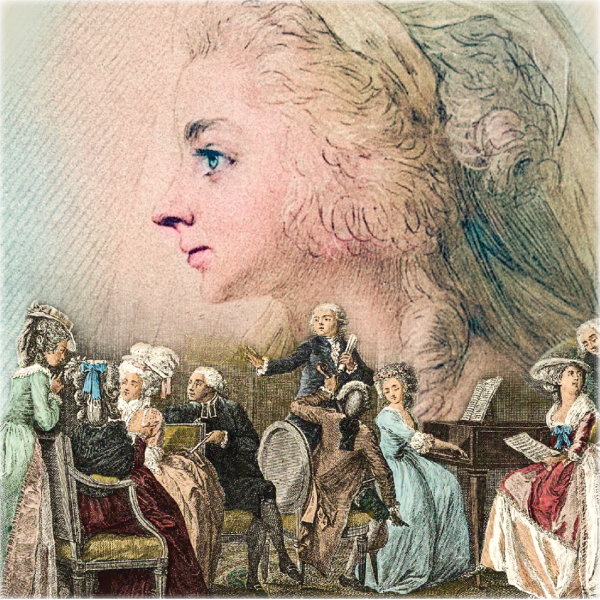
Salons held in Europe during the Enlightenment were informal gatherings where intellectuals could discuss art, philosophy, and politics of the day. Mostly hosted by women, these assemblages played a key role in promoting Enlightenment thinking and building bridges across social classes.
The salons of Sara Levy (née Itzig) were distinctive in that they focused on music-making. Born into a prominent Jewish family in Berlin, Sara and her sisters became accomplished keyboard players. Sara began hosting salons around the time of her marriage in 1783. Her salons were open to both Jewish and non-Jewish attendees, although at that time, Jewish women were not always welcome at the homes of gentiles.
Levy did not keep a journal of concerts at her salons and little correspondence survives to document what was performed, however, her profound influence on the culture of her day and for future generations is evidenced through her extensive music collection. It can be surmised that the many chamber and orchestral works that were copied out in part books (rather than remaining solely in score form) were likely performed at her salons. The five works on this program are from the portion of Levy’s collection that she subsequently gifted to the Berlin Sing-Akademie, preserving them for future generations.
Attendees to Levy’s salons included prominent scholars and musicians such as Haydn and Mozart. To further give a flavor of the atmosphere of Enlightenment thinking prevalent at the time, for these performances we are including readings of Enlightenment philosophers and writers who were in Levy’s circle or whose writings would have been known to them. They include Immanuel Kant, G.P.F. Freiherr von Hardenberg (pen name Novalis), Gotthold Ephraim Lessing, Friedrich Schiller, E.T.A. Hoffman, and Moses Mendelssohn, who was a relative of Levy.
Levy was an important proponent of the music of the Bach family. She studied with Wilhelm Friedemann, commissioned works by Wilhelm Friedemann and Carl Philipp Emanuel, and collected works by both and their father Johann Sebastian.
The Quartet in D Major by Carl Philipp Emanuel Bach is one of a set of three that were likely commissioned by Sara Levy. As her husband played flute, it is quite possible that the piece was written with both Levy and her husband in mind. Composed in 1788, they are among the last pieces he wrote and show him at the pinnacle of his expressive powers. His empfindsamkeit (sensitive style) is vividly manifested in the mercurial opening movement, with frequent shifts of mood and texture, segueing into a deeply contemplative slow movement. The work ends with a brilliant and virtuosic Allegro di molto containing some surprising dramatic twists.
Levy’s salon participants included at least a couple of fine violists as is reflected in the instrumentation of the surviving repertoire. Among the many works that included multiple violas in Levy’s collection are the three viola duets composed by Wilhelm Friedemann Bach. The intended performers of his Duet in C Major must have been nimble players as the duo is replete with lively, scampering passagework, engaging dialogue, and rhythmic energy.
The English chronicler Charles Burney described Franz Benda as one who “acquired a great reputation in his profession, not only by his expressive manner of playing the violin, but by his graceful and affecting compositions for that instrument.” In addition to violin sonatas, Benda’s oeuvre includes several beautiful sonatas for flute. Levy’s collection contained his Flute Sonata in A Minor, a work likely receiving its regional premiere in our concerts. This sonata is characterized by the profuse written-out ornamentation of its yearning opening movement and the lively dialogue between flute and bass in its fast movements, including playful bantering in the Allegro scherzando.
Although Levy’s collection focused heavily on German composers, there were a few works representing other nationalities, including a keyboard quartet by the adopted Parisian Johann Schobert. Schobert was born in Silesia and settled in Paris around 1760, where he entered the service of the Prince of Conti and became well known as a composer and virtuoso keyboard performer. The manuscript copy of Schobert’s quartet in Levy’s collection is an arrangement that substitutes viola for the second violin part. This graceful and effervescent work is written as a keyboard sonata with the strings playing an accompanimental role.
The quartet genre made up a significant portion of Levy’s collection. Her donation to the Berlin Sing-Akademie included at least 77 quartets, and among these, 40 are by Johann Gottlieb Janitsch. A double bass player and composer in the service of Frederick the Great, he was most well known as a composer of quartets that made use of colorful instrumental combinations. His Quartet in G Minor uses the unusual instrumentation of flute, two violas, and continuo, creating a dark, rich sonority. An unusual feature of this work is his quotation of the chorale Herzlich tut mich verlangen (known as the “Passion Chorale”) in the flute part of the third movement, subtitled Melodia. Here the chorale is used as a cantus firmus over the highly-ornamented interweavings of the viola parts.
— Daniel Ryan and Suzanne Stumpf